
Bespoke fragrance development is a sequence of decisions rather than a single creative act, and premium projects fail most often at the decisions a brand made too early or never revisited. This framework orders those decisions so each one is answered only when the information exists to answer it. Five gates matter: positioning, price architecture, the olfactive target, the packaging envelope and the compliance ceiling. A brand that can defend an answer at each gate can brief any credible partner and compare the answers it gets on equal terms.
Key takeaways
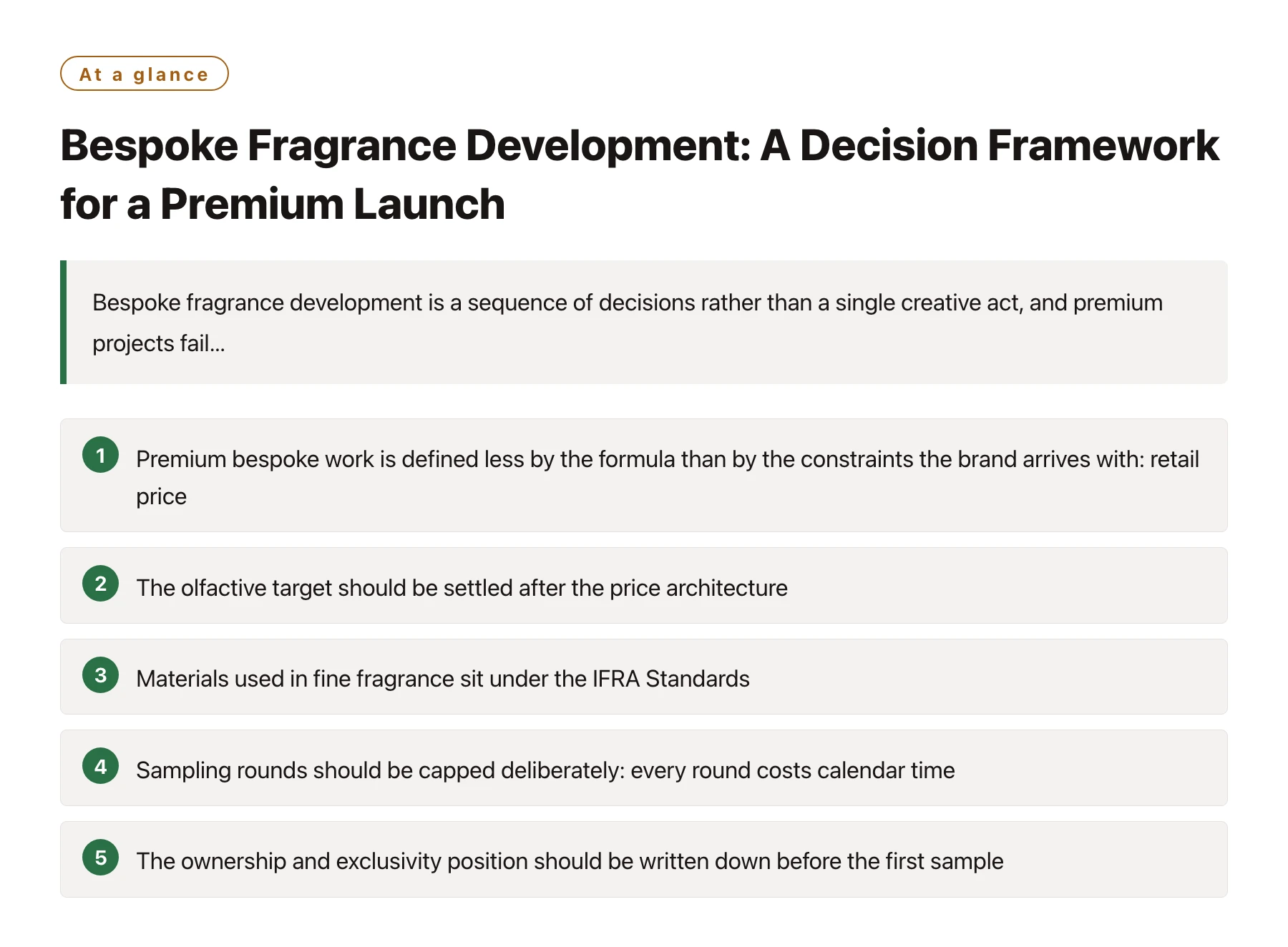
- Premium bespoke work is defined less by the formula than by the constraints the brand arrives with: retail price, packaging envelope, target markets and claims.
- The olfactive target should be settled after the price architecture, because a cost ceiling narrows the material palette before a perfumer can make good use of it.
- Materials used in fine fragrance sit under the IFRA Standards, which set use restrictions by product category, so the compliance ceiling belongs in the brief rather than at the end of development [1].
- Sampling rounds should be capped deliberately: every round costs calendar time, and a premium launch is usually limited by the schedule rather than by creative capacity.
- The ownership and exclusivity position should be written down before the first sample, because it changes the development route a supplier proposes.
- Name one decision-maker per gate. A committee that answers everything in practice approves nothing.
Bespoke development means different things in different quotes. For one supplier it means a modified library accord with the brand's name on the carton; for another it means a perfumer working from a written brief through several evaluation rounds. Both routes can be legitimate, and the difference in development cost between them is real, so the first job of a brand is to know which one it is buying.
This framework is written for a premium launch: a project where the retail price supports a developed scent and packaging that carries it, where the product may be sold in more than one market, and where the brand intends to keep the line on shelf for years rather than one season.
Five gates, in the order they should be answered
| Gate | The cheap answer that costs more later | What a premium launch asks instead |
|---|---|---|
| Positioning | "A luxury scent" with no reference point | The occasion, the wearer and the competing shelf the scent has to win on |
| Price architecture | A retail price fixed after the scent is chosen | A target cost band per unit agreed before sampling, covering concentrate, bottle, closure and carton |
| Olfactive target | A moodboard of existing products | Three explained references plus explicit exclusions |
| Packaging envelope | A bottle picked from a catalogue at the end | Fill size, format and decoration fixed early enough to test compatibility |
| Compliance ceiling | Certificates requested at the shipping stage | The markets, claims and labelling rules the formula must satisfy from the first trial |
| Ownership position | Formula ownership raised after approval | Exclusivity and re-order terms agreed before development starts |
Each gate has a cheap version and an expensive version. The cheap answers are not wrong in themselves; they become expensive when they are discovered late.
Why the price architecture comes before the scent
It is tempting to start with the scent and cost it afterwards, and on a premium launch that order is usually a mistake. The opening that the brand imagines may sit comfortably inside the budget, but the biggest jumps in unit cost rarely come from the concentrate. They come from the bottle, the closure, the decoration, the fill size and the freight per unit. Fixing a cost band first tells the development team how much room the formula has and how much room the packaging does not.
Write that band as three numbers rather than one: a target, a ceiling, and the point at which the project stops being viable. Suppliers quote to the ceiling when they are given a ceiling, and to the target only when they are told it is the target. Industry reporting on where premium tiers are actually selling is a reasonable input for choosing which band to enter, provided it informs the decision instead of replacing it [2].
A premium brief also needs a decided hero size. Thirty millilitres and one hundred millilitres of the same concentrate are not simply scaled versions of one product: the bottle, the pump, the carton and the freight per unit all move in different directions, and the smaller size often carries a disproportionate share of the packaging cost. Choosing the hero size early keeps the packaging conversation attached to the cost band.
Where premium projects usually lose their margin
The most common pattern is a scent approved against one price band and packaging chosen against another. Nothing in the process flags it, because both decisions were individually reasonable. The corrective is procedural: restate the cost band every time the packaging envelope changes, and treat a bottle change as a pricing event rather than a design preference.
Briefing an olfactive target that can actually be developed
A premium bespoke brief describes an effect and a context. "A woody amber that reads composed in a small room and is still present at the end of a working day" gives a perfumer more to work with than a note list, because it names the occasion, the environment and the required performance. Notes are still useful, but they should follow the effect rather than define it.
Exclusions remove whole branches of development and shorten the first round. A brief that says no gourmand direction, no sugary fruit top and nothing that reads as a copy of a well-known release is more useful than one that lists only preferences. It also protects the brand from approving a scent that sits too close to a competitor on the same shelf.
This is also the point at which to ask how a partner develops before asking what it can develop. A supplier that runs Xuelei's factory as a single development and production site will answer differently from a broker that forwards the brief onward. The useful questions are who perfumes the brief, how many rounds are included, how a round is presented, and what a round costs in calendar time rather than only in money.
Where the brand intends to build a line over several years, ask about the route to a second and third scent before the first is approved. A premium fragrance production partner working from an established library can often extend a range faster than a bespoke-only route, and that trade-off is worth pricing deliberately rather than discovering at the second launch.
Founders who have not launched before tend to underestimate the number of decisions that sit between an approved scent and a repeatable product. Mapping that sequence with a general guide to what it takes to launch a perfume brand before the project starts is cheaper than learning the sequence one delay at a time.
A useful discipline at the start of a premium bespoke project: write the three sentences you would use to sell the scent, and date them. If those sentences and the brief point in different directions six weeks later, one of them has drifted. Finding that out early costs a conversation; finding it out after tooling costs a launch window.
Sources
- IFRA Standards Library (International Fragrance Association) —— The IFRA Standards Library lists the restrictions the fragrance industry applies to individual fragrance ingredients, based on safety assessments; it is the reference point for compliant fragrance formulation.
- Mintel Press Centre —— Mintel's press releases on consumer and beauty market research, including fragrance and personal care trend reporting.
Frequently asked questions
How many sample rounds should a premium bespoke project plan for?
Plan for three to five evaluation rounds and treat a sixth as a signal that the brief is unclear rather than that the perfumer needs more attempts. The number matters less than the cost of each round, so ask what a round includes, how long it takes and whether rework after feedback is charged.
Should the bottle be chosen before or after the scent?
The envelope should be chosen early and the exact component later. Fill size, format and a rough price ceiling belong in the brief; the final bottle, closure and decoration can be settled once the scent direction is confirmed, provided the cost band has not moved.
Is a bespoke scent always more expensive than a library accord?
Development usually costs more, because a perfumer's time and multiple evaluation rounds are involved. At volume the difference in concentrate cost can narrow considerably, and what a brand is really buying with bespoke work is exclusivity and a brief that no one else could submit.
What does exclusivity mean in bespoke development?
It should be defined in writing as a scope: exclusivity on the finished formula, on the accords inside it, in named markets, or for a fixed period. Suppliers read the word differently, so the useful move is to state what you expect the contract to prevent rather than to rely on the term alone.
How long should a premium bespoke project take from brief to shelf?
A realistic premium launch runs across several months once sampling, stability work, packaging and filling are counted together. Calendar time is driven by the number of approval loops and by packaging lead times more than by the perfumery itself, so the schedule should be built backwards from the shelf date.