
Jewelry ODM vs OEM: A Decision Table for Brands
The choice between OEM and ODM is not a quality judgement. It is a question about who supplies the design and who carries the risk if the design is wrong. Both routes use the same bench, the same 25–30 day sample stage and the same 21–28 day production run; they differ at the point where the file is created.
Key takeaways
- Same factory, same minimums: 50 pieces per design in silver, 100 in brass, 100 or more in stainless, whichever format is chosen.
- OEM begins with the buyer's CAD and keeps the IP with the buyer; ODM begins with a brief and produces a collection exclusive to the brand.
- An extra concept-approval week plus the modelling step pushes an ODM route to 55–67 days, against 46–58 for an OEM order with a finished file.
- Both formats end at 100% final inspection, so the decision changes ownership and authorship, not the quality gate.
Two starting points, one production line
OEM means the buyer arrives with a design and the factory produces it. ODM means the buyer arrives with an intention and the factory develops the design before producing it. Everything after the model exists is close to identical: pattern, sample, approval, bulk run and final check.
That is why the decision is often made later than it should be. Brands spend weeks comparing factories on capability when the more useful question is internal: does anyone on the team hold a finished drawing, and can they defend it in a technical conversation?
A team with a product developer and a CAD file is ready for OEM. A team with a mood board, a launch date and no model is ready for ODM, whether or not it uses that vocabulary.
Timing gives a rough guide to the gap. A finished file can enter modelling within a day, and that modelling takes under 48 hours. A brief has to pass through concept discussion first, and the length of that conversation depends on how many open questions the references leave.
Where the IP sits, and why it decides the format
In OEM the buyer owns the design outright. The factory builds to the supplied file, and the published terms put IP ownership at 100% for the buyer. That is the cleaner arrangement for a brand with a signature shape it intends to defend.
In ODM the factory develops the concept, and the resulting collection is co-created but exclusive to the brand. The published commitment is that moulds, CAD and the collection are not resold or shown, backed by a 100% NDA. The brand still sells something nobody else has, but the authorship is shared.
For most brands the ownership clause matters less than the practical question: who fixes the design when it fails? Under OEM the answer is the buyer's team. Under ODM it is the factory's development bench, working from the brand's brief. The OEM/ODM label describes the default, and a written scope can move that default in either direction.
The decision table
Five criteria separate the routes in day-to-day work. They are worth scoring before a supplier conversation, because each one has a factual answer rather than a preference.
| Criterion | OEM | ODM | Question that settles it |
|---|---|---|---|
| Starting input | Buyer's CAD file | Brief, references or mood board | Is there a finished drawing on day one? |
| IP ownership | Buyer owns 100% | Collection exclusive to the brand | Who must control the file? |
| Design authorship | Factory builds to spec | Factory develops the concept | Who signs off the design? |
| Sampling | 25–30 days against the file | 25–30 days after concept development | Is the concept already resolved? |
| Typical fit | Established ranges, tight tolerances | New collections, small design teams | Is speed or authorship the priority? |
What does not change between the two
The minimum order is set by the material, not by the format. Silver begins at 50 pieces per design, brass at 100 and stainless at 100 or more, so a brand cannot lower a threshold by switching from one route to the other.
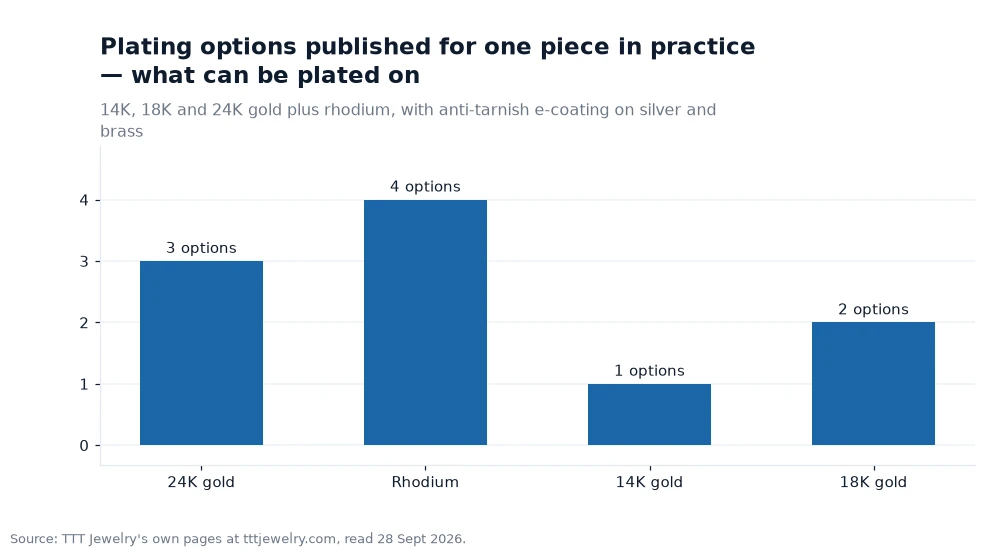
The finishing options are identical as well. Multi-layer 14K, 18K or 24K gold plating, rhodium, anti-tarnish e-coating on silver and brass, and PVD vacuum plating on stainless are available to both formats, because they are process choices rather than design choices.
Compliance works the same way. ISO 9001:2015 applies to the production system regardless of who wrote the drawing, and REACH and CA Prop 65 apply to the plating whichever route produced it. The format changes the paperwork at the front of the project, not the certification behind it.
Packaging is shared too. Metallic logo tags, foil-stamped gift boxes, velvet or microfiber pouches, display backing cards and barcode labelling are all specified per order, so a brand can present an OEM repeat and an ODM debut in identical retail dress.
Brands that already hold a finished CAD file can view OEM services first, because that route assumes the design decision is closed and only the production decision remains.
Worked example
Take a four-design sterling capsule at the published 50-piece minimum, so 200 units. Compare the calendar for a brand with a finished CAD file against one starting from a brief.
For the prepared brand, sampling takes 25–30 days and production 21–28, giving 25 + 21 = 46 to 30 + 28 = 58 days. The published 48–60 day total assumes the 2-day modelling step is included, which it is not here because the file already exists.
For the brand starting from a brief, add the 2-day modelling step and an approval loop on the concept. One week of concept review turns the route into 7 + 2 + 25–30 + 21–28 = 55–67 days. The gap between the two brands is 9 days at both ends, and it comes entirely from decisions rather than from production.
Frequently asked questions
Is ODM cheaper than OEM?
Not inherently. Both carry the same material minimums and the same sample and production windows, so the difference sits in who performs the development work rather than in a fixed price gap.
Can a brand switch from ODM to OEM later?
Yes. Once a collection exists the brand holds an approved design, and later orders can be placed as OEM against that file if the ownership terms allow the transfer.
Does ODM mean the factory can sell the design to others?
No. The published terms state that the collection, its moulds and its CAD are exclusive to the brand and are not resold or shown to other clients.
Choosing a format without overcommitting
Start with the file, not the format. If the drawing exists and the tolerances are known, OEM is the shorter conversation. If the drawing does not exist, ODM is the honest description of the work.
Either route can be tested at a modest scale before a full range is committed. A single design at the material minimum is enough to judge communication, sample quality and finishing, and the factory direct manufacturing model keeps that test close to the production line rather than behind an agent.
For programmes built around seasonal drops, the custom jewelry wholesale route usually combines both formats: a few ODM pieces to open a collection and OEM repeats once the shapes prove themselves.
Source note: figures come from the manufacturer's own website (tttjewelry.com), read 28 Sept 2026.[1